
Sailing with Bob and Melinda on SV Counting Stars! (Day 4)

Calm seas, but head-on winds

After a very refreshing night of sleep in an actual bed (not on various spots in the cockpit and saloon), we woke up early to another beautiful day! 

We did our morning checks of the engines, cleaned the raw water strainers and had breakfast. We pulled up the anchor, secured it and the bridle and started our trip up the outside of the Keys.  Our plan was to get to No Name Harbor, located at the very bottom of Biscayne Bay, just South of Miami.
This was one of our stops during our ASA sailing school and is a great anchorage. 

This day was pretty uneventful.  Even though the trip from Boot Key to Biscayne Bay requires a gradual turn to port for the entire trip, the wind magically made the same turn and we motored the entire way.
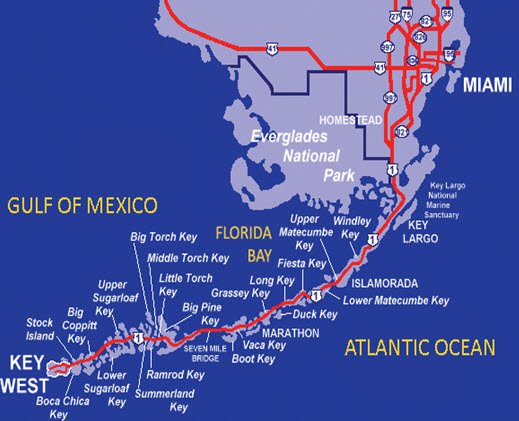
Map Of Florida Keys
At this point, we had sailed about 200 nautical miles and tacked once.  But, that's sailing, at least sailing on a schedule.

We all took turns at the helm again and we all got to chat and get to know each other a lot better.  (What a really cool group of people!)

Andy was even starting to feel a lot better; which was good, as the look at the mast through the binoculars on the first leg of our trip really did a number on him.

We were given a beautiful sunset over the Keys...


...but we still had a hour or two to get to No Name Harbor.

We arrived at the cut that eventually leads into the No Name Harbor area, which is right next to Stiltsville.  Stiltsville is a collection of houses built back in the 1930s that are basically just off the coast, in the Atlantic, in Hurricane central, and amazingly there are a lot of them still left.

There is a narrow channel between two rows of them with 1 or 2 lighted markers at the end of the channel with the rest just being reflective.  Here is what they looked like as we arrived.


We ended up going pretty damn close to the unlit markers, so I took the rechargeable spotlight to the Bow and alternated between port and starboard, spotting the channel markers.  This took about 10-15 minutes to get to just outside No Name Harbor.

The anchorage in the Harbor looked full and there were about 4 boats outside the Harbor in the anchorage, so we went to the end of the row and dropped the hook there.  Bob used the radar to make sure there were no smaller, unlit boats that we weren't seeing.  The beautiful 50' Xquisite Catamaran was hard to miss.  (By the way, if money were no object, that could easily be first choice.)

We dropped the anchor, but there was not great protection from the wind and currents, so after a few minutes laying in bed, Bob and I decided to let out some more scope and make sure the anchor was holding.  We also set the anchor alarm (three actually, the helm MFD, Bob's phone and my phone) so we'd know if we dragged at all and then went to bed.

There was a little wave action, but this never bothered me and we fell quickly to sleep.

Comments

Popular posts from this blog

Victron Isolation Transformer - How to lower the output voltage

Re-configuring a Victron Energy isolation transformer This is a companion article to a YouTube video  covering the same topic. What are they and why do I need one? Victron Energy isolation transformers are often used on boats that connect to shore power in order to provide a means of providing isolation between the shore power and the AC power that exists on the boat.  The transformer sits in between those two worlds and isolates that two power supplies through magnetic flux and an air-gap. The reason this is needed on a marine vessel is because without it, small leakage currents can flow between the earth ground for shore power and the "earth ground" connection on the boat, which is usually connected to water through a propeller shaft, out-drive, sail-drive or sacrificial zincs. That creates a loop and that small leakage current greatly accelerates any galvanic corrosion that naturally happens. Current flows through the water because of the salt content, or even in fresh-wat...

Common Questions from other Vision Owners

Update: 7 Oct 2024 Before we get to the blog article, which I wrote in March of 2023, I want to let you know that I just found out about Google's NotebookLM, which is an AI powered tool that allows you to create a Podcast style audio piece based off of whatever input you provide, in this case, the following article. Here is a link to the "podcast" it created . Honestly, I'm blown away! Original Article follows... Introduction  I received a list of questions from Steve and Lisa Heidenthal (Hull #13, Sla'inte) about how we set up our boat, where we purchased things in SA and instead of just answering them for Steve, I thought I might as well make a blog article to also help others. All of these answers will be from the following perspective: sailing the boat over from SA to where-ever having the boat built with strictly 230V/50Hz power If the boat is being shipped, I wouldn't suggest buying much in SA, as you will have an easier time finding more options (and us...

Using a NAS (Network Attached Storage) device on a boat as your own personal Cloud.

Living on a self-sufficient boat without giving up The Cloud?! If you are at all like me, you've begun to rely more and more on one or more Cloud Services.  Apple iCloud, Dropbox, Google Drive, Microsoft OneDrive and many, many more basically all offer the same solution: "You have digital things that are important to you; you pay us a small amount per month and we'll manage keeping it safe and protect you from hardware failures and data loss." I firmly believe that hosted cloud storage is one of the great conveniences that just about anyone under the age of 70 should be using.  The solutions are downright cheap, given how much storage capacity you can get and how much you would pay to get that data back if you lost it. I have used all of the above and my provider of choice is Google Drive, though we also use Apple iCloud to automatically backup our iDevices, as least for now. Life 2.0 We will still have a cloud storage provider when we set sail, but what are we going ...