
Gulf Stream Crossing - Check!

Synopsys: I would be lying if I said it was smooth sailing.  

Left Thunderbird

We left Thunderbolt, a suburb of Savannah, around 10:00 on the 20th and started the two hour motor down the river to get to the Atlantic. We got a nice send off by dolphins on the way but quickly remembered how far Savannah is inland for such a major port.

Anyways we made it to the Atlantic and the waves had certainly settled down from where they were a few days ago, but that's not really saying much, as we later found out that cruise ships were waiting in Freeport extra days for the weather to calm down!

Waves were pretty short period and around 4-5' close to shore.  They got larger, but at least longer period as we got further offshore. They were hitting us on the beam, maybe a little forward, which does not result in a super pleasant sail. This was proved out because Abe became seasick soon after we entered this weather and went down to his cabin to rest around 1PM on the 20th.  Sue starting feeling less than ideal around 5PM.  

No problem, I'll buckle down and take some longer shifts until they started feeling better. That was a great plan in theory.  In practice, I decided to check on Abe 24 hours later when he hadn't surfaced since. He was awake, but every time he tried to get out of bed, no bueno. Sue was a little better. She was feeling off, but was able to take couple hour shifts at the helm before needing to take a break.  

Single-handing?

Long story short, Abe was basically confined to his bed for almost 72 hours because of how hard this bout of seasickness hit him!  Sue starting doing better on the third day as we made it across the Gulf Stream and things started to calm down.  This is all relative, we were done with the 8-9 foot waves and back to 3-5 footers.

We did manage to sail for almost the entire time and were making good progress if not for the current, which ran at up to 4 knots against us at times.  The expected 48 hour trip turned into 72 hours.  
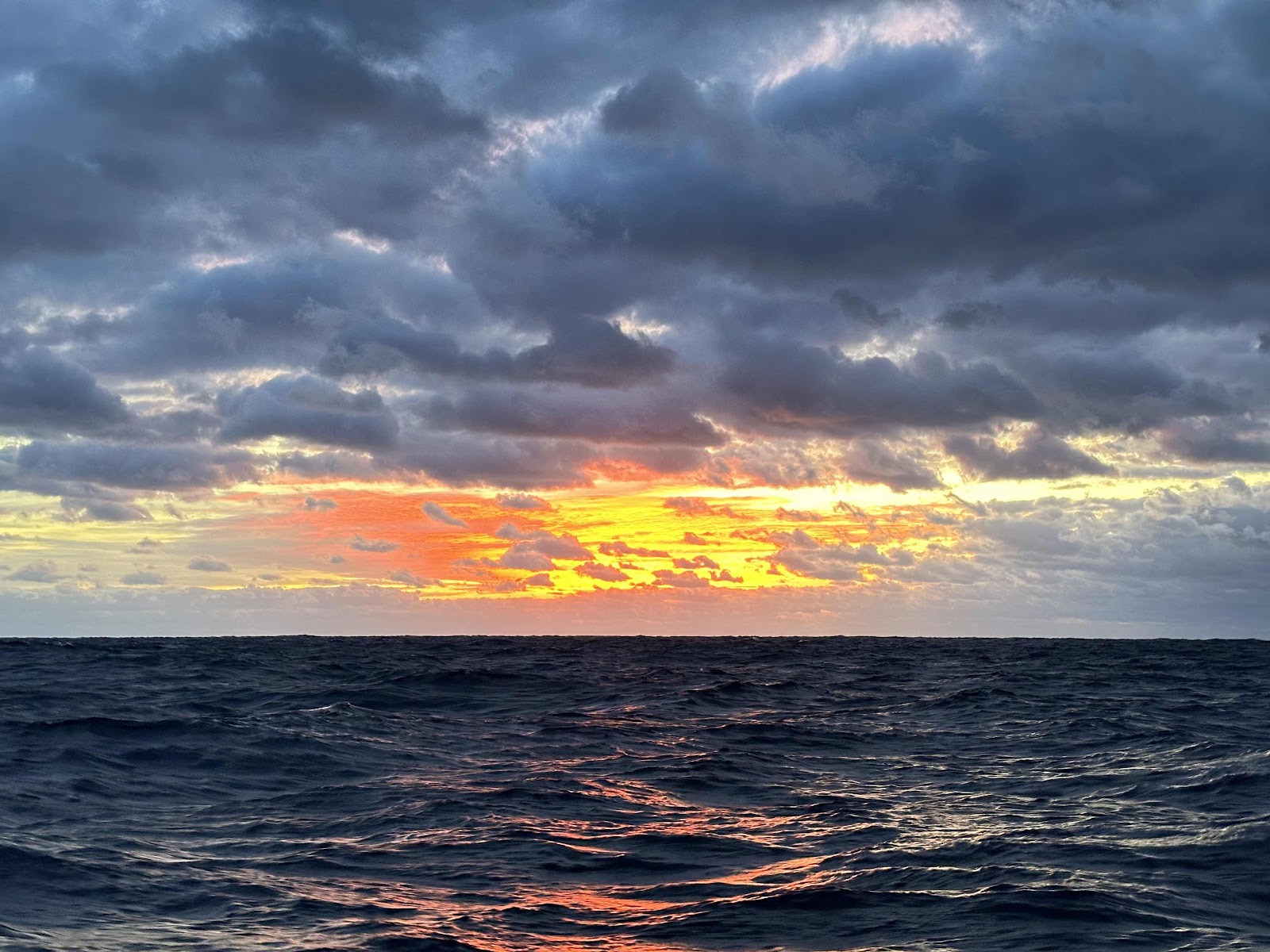


Land!

We got into Bahamian waters around midnight on the 22nd and still had about 6-7 hours to get to Lucaya, a suburb of Freeport and a friendlier place to clear-in than the very large, commercial port of Freeport.

Navigating close to shore in The Bahamas when dark is generally considered a terrible idea. While there are channels between islands that are a mile deep, as you get close to land, that can quickly drop to 5' or less and there are coral heads. They are not soft. We were happy to be arriving near Lucaya just as the sun was rising, so we wouldn't have to just wait around for daylight. Actually, thinking back and through sheer luck, the timing was pretty much perfect.

The Bahamas

The weather the day we arrived was really nice. We made our way into the relatively narrow channel that goes to Lucaya, then a quirk turn to starboard and the Grand Bahama Yacht Club, where we could check-in to the country, was right there. 


We used their online portal to enter all of our clearing-in information so the visit to the Customs and Immigration office only took about 20 minutes. $300 and we are good to be in The Bahamas for up to 3 months. Of course, as we are on our way back to the boat to shove-off and go the last little bit to the dock-space we rented, the dockhand informed us that they now charge a $50 landing fee.  Of course everything online and in the cruising guidebooks says no charge. After arguing for a few minutes got nowhere, we paid and moved on.  

Scarborough Docks and Villas

We try to anchor whenever possible, however, that's not an option in Lucaya. Fortunately, we stumbled across an entry in AquaMap (BTW, we love this app; if you are a cruiser, you need to use this software!) for what ended up being a fantastic stop for a very fair $75/night, including water, trash and electricity. The owner, Giles, met us at the dock and we were quickly tied up and the trip was done!


Time to Recover

After securing lines and making sure everything was situated, I crashed for a few hours! Abe had a flight the day we arrived and Giles was nice enough to offer to drive him to the airport, so we did make sure we were up to send him off and thank him for travelling with us and then I'm pretty sure we turned in super early to get ourselves back to good.

Comments

Popular posts from this blog

Victron Isolation Transformer - How to lower the output voltage

Re-configuring a Victron Energy isolation transformer This is a companion article to a YouTube video  covering the same topic. What are they and why do I need one? Victron Energy isolation transformers are often used on boats that connect to shore power in order to provide a means of providing isolation between the shore power and the AC power that exists on the boat.  The transformer sits in between those two worlds and isolates that two power supplies through magnetic flux and an air-gap. The reason this is needed on a marine vessel is because without it, small leakage currents can flow between the earth ground for shore power and the "earth ground" connection on the boat, which is usually connected to water through a propeller shaft, out-drive, sail-drive or sacrificial zincs. That creates a loop and that small leakage current greatly accelerates any galvanic corrosion that naturally happens. Current flows through the water because of the salt content, or even in fresh-wat...

Raising the dinghy, easier!

The Davit System The Vision 444 comes with a Carbon Fiber Davit system that is used to hoist a dinghy.  As time has gone on, some of the exact specifics of the davit system have evolved and changed slightly, but for our boat (Hull #11) and the ones near to it, this is how it operates.  Two Main Steps First, after attaching the dinghy to a forward and aft attachment line, the davit arms are raised; pivoting on axles which mount the davit to the transom of the boat.  This step is accomplished by attaching a line which runs through several blocks to the starboard, aft power winch.  Pressing "2" (low speed) on the winch power buttons and raising the davit into its full upright position, where it can be lashed to the boat with Dyneema loops. Second, is to raise the dinghy to be close under the horizontal beams of the davit arms.  The dinghy attachment lines, that are attached to the dinghy's bridle, run up through a fixed block at the end of the davit arms and then t...

Vision 444 - How to (hopefully never have to) use a Storm Sail

 How to use the Storm Sail on a Vision 444 My fellow Visionary Pierre on Umbono reached out recently wanting to review the steps for deploying the Storm Sail, since he was forecasted to be in less-than ideal sailing conditions in the next day. What better opportunity to write a blog article! This is going out quickly to support Pierre, but I will come back and add pictures and maybe link a video later. Preparation Keep the Storm Sail and everything you need for it somewhere where it is easy to get. We keep ours in the large lazarette under the Cockpit table seating. If you think you might need the Storm Sail, you probably should have the jacklines put out too.  The system we use to deploy the Storm Sail reduces the time we need to be forward, but wearing a life vest with harness and being clipped into the lazy jacks is the way to go here. Our Storm sail is in it's own bag with the following: A port sheet attached to the clew with a bowline A starboard sheet attached to the cle...